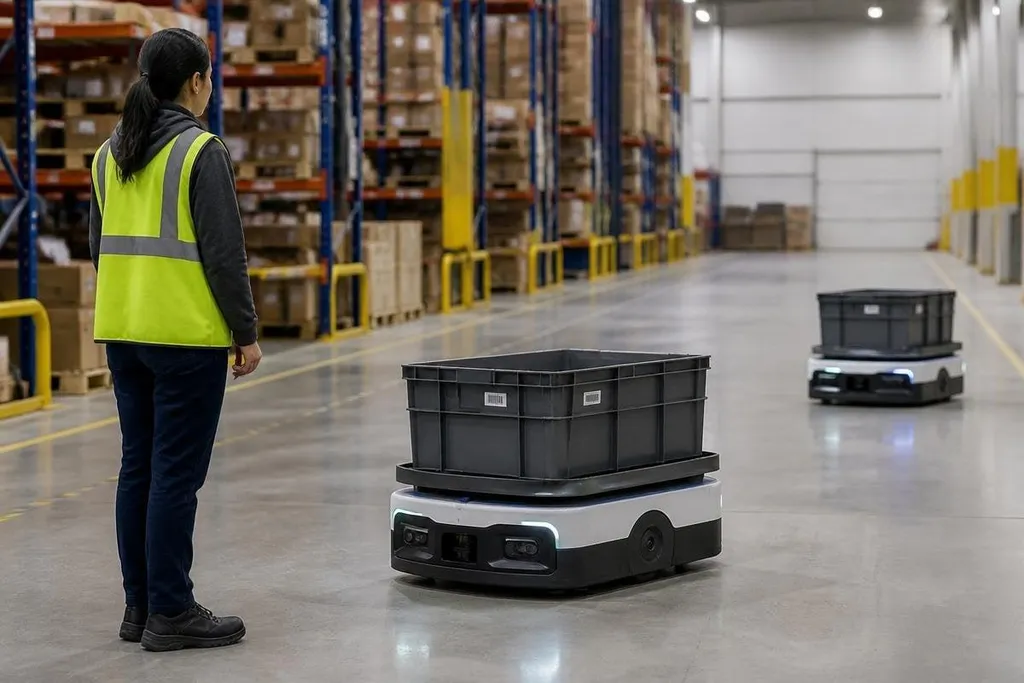
A warehouse robot can choose a route without asking a person at every turn. A surgical robot, a security system, or a machine controlling heavy equipment needs a much tighter human check. The right rule depends on what can happen when the robot gets it wrong.
- Low-risk movement can run without approval for every action.
- High-risk choices need a clear stop command and a named person in charge.
- Every serious decision should leave a record that people can inspect.
Give people control where failure can hurt
A robot should act on its own when the task is limited, visible, and easy to reverse. A mobile robot moving empty bins through a marked work area fits that pattern. Its software can pick a route, slow down near an obstacle, and stop when a sensor sees a person.
The decision changes when the robot can injure someone, damage costly equipment, deny access, or affect a person’s rights. In those cases, human control needs more than a button on a wall. A person must know what the robot plans to do, why it reached that choice, and how to stop it before harm occurs.
An emergency stop is one part of this setup. So are speed limits, restricted work zones, manual controls, and a rule that sends uncertain cases to a person. These controls work best when they are tested during normal operation, not added after the first serious fault.
“Final say” can mean several things
People often treat human approval as one simple step. In practice, control can sit at different points in the system.
A person might approve the robot’s goal before a task starts. The robot then chooses the route and handles small changes on its own. Another design lets the robot act until it reaches a set limit, such as a force reading, a restricted area, or an uncertain object ID.
A third design gives a supervisor the power to pause, reject, or reverse an action. That person may not inspect every movement, yet they remain responsible for the rules and the response when the system stops behaving as expected.
This matters because constant approval can slow work and create rushed decisions. A supervisor who must approve 500 low-risk movements may pay less attention when a serious alert appears. Good control gives people fewer routine interruptions and stronger checks at the points that carry real risk.
Autonomy needs records and limits
The robot’s decision should be traceable after the event. The system should record the task it received, the sensor data used, and the action it took.
It should also record any point where a person changed or stopped that action. Those records help a team fix a bad rule instead of blaming the operator for a result they could not see coming. They also show whether the robot stayed inside its approved limits.
A log without the robot’s reason for choosing an action has limited value, so the record needs enough detail for a later review.
A factory arm can work inside marked limits, while a delivery robot shares roads and sidewalks with people. Those settings call for different rules about who may stop the system and when. Robot24.com's robotics coverage can tie each rule to named machines, test sites, and deployment records, so the policy fits the risk before software handles a split-second response.
The hardest cases involve systems that act faster than a person can react. A human may still set the speed limit, approve the operating area, and review the logs, while software handles the split-second response. The person has control over the system’s boundaries, even when they cannot approve each motor command.
A practical control checklist
Use these questions before giving a robot more freedom:
- Define the harm: What can go wrong, and who could be affected?
- Set the limit: Which speed, force, area, or task must trigger a stop?
- Name the supervisor: Who can pause the robot, and who can change its rules?
- Show the reason: Can the operator see why the robot chose that action?
- Keep the record: Does the system save commands, alerts, sensor input, and overrides?
- Test the stop: Can a person halt the robot quickly from the place where they work?
These answers should shape the system before deployment. A robot that only moves stock inside a fenced area may need broad operating freedom. A robot that handles medication, vehicles, weapons, or personal data needs narrower limits and closer review.
The rule worth using
Humans shouldn’t approve every robot action by habit. They should control the robot’s goals, limits, stop conditions, and access to risky actions, then review the evidence when the system acts on its own.
I’d give a robot more freedom only when its task is reversible, its operating area is controlled, and a person can stop it without guessing what the software is doing.
That leaves one practical test: before a robot receives a new task, can the team name the action it may take, the limit that stops it, and the person who answers when it crosses that limit?